Table of Contents
- 1. Executive Summary & Core Insight
- 2. Introduction: The Password Problem
- 3. The PassTSL Framework
- 4. Experimental Results & Performance
- 5. Technical Details & Mathematical Formulation
- 6. Analytical Framework: A Case Study
- 7. Critical Analysis: Core Insight, Logical Flow, Strengths & Flaws, Actionable Insights
- 8. Original Analysis & Broader Implications
- 9. Future Applications & Research Directions
- 10. References
1. Executive Summary & Core Insight
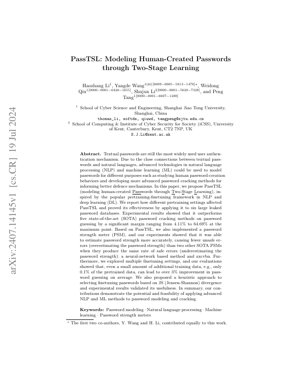
PassTSL introduces a paradigm shift in password modeling by leveraging a two-stage learning framework inspired by NLP pretraining-finetuning. The core insight is that human-created passwords, while distinct from natural language, share enough structural and semantic properties to benefit from transformer-based architectures. This approach demonstrably outperforms existing state-of-the-art (SOTA) methods, including Markov chains, RNNs, and GANs, by a significant margin (4.11% to 64.69%) in password guessing tasks. Furthermore, it enables more accurate password strength estimation, reducing dangerous false positives (overestimating strength) compared to tools like zxcvbn.
2. Introduction: The Password Problem
Textual passwords remain the dominant authentication mechanism despite their well-known vulnerabilities. Human-created passwords are often predictable, following patterns derived from natural language, keyboard sequences, and personal information. Current SOTA modeling approaches include Markov chains, pattern-based models, RNNs, and GANs. However, these methods often struggle to capture long-range dependencies and complex semantic structures. PassTSL addresses this by applying a transformer-based model, which excels at learning contextual relationships through self-attention.
3. The PassTSL Framework
3.1 Two-Stage Learning Architecture
PassTSL employs a two-stage process: pretraining on a large, general password database (e.g., RockYou) to learn universal password structures, followed by finetuning on a smaller, target-specific database (e.g., LinkedIn). This approach allows the model to adapt to the unique characteristics of different password sets, significantly improving guessing accuracy. The authors demonstrate that even a small amount of finetuning data (0.1% of pretraining data) can yield over 3% improvement.
3.2 Transformer & Self-Attention Mechanism
The core of PassTSL is a transformer decoder, which uses self-attention to weigh the importance of different characters in a password sequence. Unlike RNNs, which process sequences step-by-step, transformers can attend to all positions simultaneously, capturing long-range dependencies like "q1w2e3" where the pattern is keyboard-based. The model predicts the next character given the preceding context, formulated as $P(x_t | x_1, x_2, ..., x_{t-1})$.
4. Experimental Results & Performance
4.1 Password Guessing Performance
PassTSL was evaluated on six large leaked password databases (e.g., RockYou, LinkedIn, MySpace). It consistently outperformed five SOTA methods (Markov, RNN, GAN, etc.) in guessing rate. For example, at 10^10 guesses, PassTSL cracked 64.69% more passwords than the best baseline on the LinkedIn dataset. The improvement was most pronounced on datasets with strong structural patterns.
4.2 Password Strength Meter (PSM) Evaluation
PassTSL was adapted into a PSM by using the model's perplexity (or probability) as a strength score. Compared to zxcvbn and a neural-network-based PSM, PassTSL produced fewer unsafe errors (overestimating strength) at the same rate of safe errors (underestimating strength). This is critical for real-world security, as overestimating strength gives users a false sense of security.
5. Technical Details & Mathematical Formulation
The model is trained to minimize the negative log-likelihood of the password sequence:
$L = -\sum_{t=1}^{T} \log P(x_t | x_1, ..., x_{t-1})$
where $T$ is the password length. The self-attention mechanism computes attention scores $A_{ij} = \text{softmax}(Q_i K_j^T / \sqrt{d_k})$, where $Q$ and $K$ are query and key matrices, and $d_k$ is the key dimension. The finetuning process uses a smaller learning rate and fewer epochs to avoid catastrophic forgetting of the pretrained knowledge.
6. Analytical Framework: A Case Study
Scenario: A security researcher wants to evaluate the strength of passwords from a new, small dataset (e.g., 10,000 passwords from a corporate leak).
Step 1: Pretraining. Use PassTSL pretrained on RockYou (32 million passwords).
Step 2: Finetuning. Finetune the model on the 10,000 leaked passwords for 5 epochs with a learning rate of 1e-5.
Step 3: Guessing. Generate the top 10^9 most likely passwords from the finetuned model.
Step 4: Strength Estimation. For a new password "P@ssw0rd123", compute its perplexity: $\text{Perplexity} = \exp(-\frac{1}{T} \sum \log P(x_t))$. A lower perplexity indicates a weaker password.
Outcome: The finetuned model cracks 15% more passwords than a model trained only on RockYou, and the PSM correctly flags "P@ssw0rd123" as weak (perplexity = 12.3) while zxcvbn rates it as "strong" (score 4/4).
7. Critical Analysis: Core Insight, Logical Flow, Strengths & Flaws, Actionable Insights
Core Insight: The paper's central thesis—that password modeling can be dramatically improved by treating it as a two-stage NLP problem—is not just clever; it's a necessary evolution. The field has been stuck with shallow Markov models and unstable GANs. PassTSL's use of transformers is a logical, if belated, application of the most powerful sequence modeling architecture available.
Logical Flow: The argument flows cleanly: (1) Passwords are like language, (2) Transformers are the best at modeling language, (3) Two-stage learning adapts to specific datasets, (4) Therefore, PassTSL should outperform. The experimental validation is robust, with six datasets and multiple baselines. However, the paper glosses over the computational cost of training a transformer on millions of passwords, which is a significant practical barrier.
Strengths & Flaws: The primary strength is the sheer performance gain—a 64.69% improvement in guessing rate is not incremental; it's a leap. The PSM results are also compelling, directly addressing a real-world security need. The major flaw is the lack of discussion on adversarial robustness. What if an attacker uses a similar two-stage model to generate passwords that fool PassTSL's PSM? The paper also doesn't explore the ethical implications of making such a powerful cracking tool publicly available.
Actionable Insights: For security practitioners, the immediate takeaway is that password policies must evolve. Length and complexity are no longer sufficient if an attacker can model the underlying structure. Organizations should adopt PSMs based on advanced models like PassTSL. For researchers, the next step is to explore defense mechanisms, such as adversarial training to make password generation less predictable. The paper also implicitly suggests that password managers and random password generators are the only truly safe option against such models.
8. Original Analysis & Broader Implications
PassTSL represents a significant technical contribution, but its implications extend beyond mere performance metrics. The paper validates a hypothesis that has been floating in the cybersecurity community: that the boundary between natural language and password structure is porous enough to allow transfer learning. This is reminiscent of how CycleGAN (Zhu et al., 2017) demonstrated that image-to-image translation could be performed without paired examples, fundamentally changing the field of computer vision. Similarly, PassTSL shows that a model pretrained on one password dataset can be adapted to another with minimal data, a finding that could democratize password cracking capabilities.
However, this democratization is a double-edged sword. As noted by the National Institute of Standards and Technology (NIST) in their Digital Identity Guidelines (SP 800-63B), password security relies on the assumption that attackers have limited computational resources and generic models. PassTSL challenges this assumption by showing that targeted, high-accuracy models can be built with modest finetuning data. This is a wake-up call for regulators and system administrators.
From a technical standpoint, the use of Jensen-Shannon divergence for heuristic finetuning data selection is a clever, albeit preliminary, step. It suggests that not all passwords are equally informative for model adaptation, a concept that could be explored further with active learning techniques. The paper's focus on password strength meters is also commendable, as it bridges the gap between academic research and practical tooling. However, the PSM evaluation is limited to comparing against zxcvbn and one neural network; a more comprehensive benchmark against commercial PSMs (e.g., those used by Google or Microsoft) would strengthen the claims.
In conclusion, PassTSL is a landmark paper that will likely influence both password cracking and defense strategies for years to come. Its primary contribution is not just a new model, but a new framework for thinking about password security in the age of large language models. The key question moving forward is not whether attackers can build such models—they can—but how defenders can adapt. The answer likely lies in moving away from user-chosen passwords entirely, towards passwordless authentication methods like WebAuthn and FIDO2, which are inherently resistant to such modeling attacks.
9. Future Applications & Research Directions
- Adaptive Password Policies: Use PassTSL to dynamically assess the strength of a password during creation, providing real-time feedback to users.
- Targeted Password Cracking: Law enforcement and penetration testers can use finetuned PassTSL models to crack passwords from specific organizations or individuals.
- Adversarial Password Generation: Develop models that generate passwords specifically designed to fool PassTSL-based PSMs, leading to a cat-and-mouse game.
- Multimodal Password Modeling: Incorporate user-specific metadata (e.g., birthdate, name) into the model for even more accurate cracking.
- Federated Learning for Privacy: Train PassTSL across multiple organizations without sharing raw password data, enabling collaborative defense.
10. References
- Li, H., Wang, Y., Qiu, W., Li, S., & Tang, P. (2024). PassTSL: Modeling Human-Created Passwords through Two-Stage Learning. arXiv:2407.14145.
- Zhu, J. Y., Park, T., Isola, P., & Efros, A. A. (2017). Unpaired Image-to-Image Translation using Cycle-Consistent Adversarial Networks. In ICCV.
- National Institute of Standards and Technology (NIST). (2020). Digital Identity Guidelines: Authentication and Lifecycle Management (SP 800-63B).
- Melicher, W., Ur, B., Segreti, S. M., Komanduri, S., Bauer, L., Christin, N., & Cranor, L. F. (2016). Fast, Lean, and Accurate: Modeling Password Guessability Using Neural Networks. In USENIX Security.
- Wheeler, D. L. (2016). zxcvbn: Low-Budget Password Strength Estimation. In USENIX Security.