1. Introduction & Overview
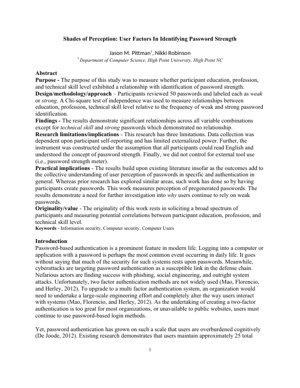
Password-based authentication remains the dominant security mechanism in digital life, yet it is fundamentally flawed. Users are cognitively overburdened, managing an average of 25 password-protected accounts and entering passwords eight times daily. Despite widespread knowledge of best practices, weak passwords persist, making systems vulnerable to phishing, social engineering, and brute-force attacks. This research shifts the focus from password *creation* to password *perception*, investigating whether a user's background—specifically their education level, profession, and self-reported technical skill—influences their ability to correctly judge password strength. The study's premise challenges the assumption that users inherently understand what constitutes a 'strong' password, a critical gap in security education and tool design.
2. Research Methodology
2.1 Study Design & Participants
The study employed a survey-based design with a broad participant spectrum. Participants were presented with 50 pre-generated passwords and asked to label each as 'weak' or 'strong'. No password strength meters were provided, isolating innate perception. Demographic data on education (e.g., high school, bachelor's, graduate), profession (IT vs. non-IT), and self-assessed technical skill level (e.g., novice, intermediate, expert) was collected via self-reporting.
2.2 Data Collection & Analysis
Frequency counts of 'weak' and 'strong' classifications were compiled for each participant group. The core analytical tool was the Chi-square test of independence ($\chi^2$), used to determine if a statistically significant relationship existed between each independent variable (education, profession, skill) and the dependent variable (password strength identification frequency).
3. Key Findings & Results
Key Result Summary
Significant Relationships Found: Between participant education/profession and frequency of identifying both weak and strong passwords.
Notable Exception: No significant relationship found between technical skill level and identification of strong passwords.
3.1 Statistical Relationships
The Chi-square tests revealed significant relationships (p < 0.05) for most variable combinations. This suggests that a user's educational background and professional field do correlate with how they perceive password strength. For instance, individuals with higher education or in IT-related professions showed different judgment patterns compared to others.
3.2 The Technical Skill Paradox
The most counterintuitive finding was the lack of a significant relationship between self-reported technical skill and the ability to identify *strong* passwords. While technical skill correlated with spotting *weak* passwords, it did not confer an advantage in recognizing truly strong ones. This exposes a critical flaw in relying on user self-assessment or general technical competence for security judgment.
4. Technical Details & Analysis Framework
4.1 Chi-Square Test of Independence
The analysis hinged on the Chi-square test, formulated as: $\chi^2 = \sum \frac{(O_i - E_i)^2}{E_i}$, where $O_i$ is the observed frequency (e.g., number of 'strong' calls from IT professionals) and $E_i$ is the expected frequency if no relationship existed. A high $\chi^2$ value relative to degrees of freedom indicates the variables are not independent.
4.2 Analysis Framework Example
Case: Analyzing Profession's Impact
Step 1: Create a contingency table: Rows = Profession (IT, Non-IT), Columns = Judgment (Correct on Strong Passwords, Incorrect on Strong Passwords).
Step 2: Calculate expected frequencies assuming no relationship. E.g., Expected IT-Correct = (Row Total IT * Column Total Correct) / Grand Total.
Step 3: Compute $\chi^2$ using the formula above.
Step 4: Compare calculated $\chi^2$ to critical value from $\chi^2$ distribution table with appropriate degrees of freedom (df = (rows-1)*(cols-1)). If calculated > critical, reject the null hypothesis of independence.
5. Limitations & Implications
5.1 Research Limitations
- Self-Reporting Bias: Data on skill and profession relied on participant honesty and self-perception, which may not reflect objective ability.
- Language & Concept Assumption: The study assumed English literacy and a baseline understanding of 'password strength,' potentially excluding or misrepresenting some populations.
- Lack of Tool Control: The study did not prevent participants from using external password checkers, though the design aimed to measure innate perception.
5.2 Practical Implications
The findings underscore that password security cannot be delegated to user intuition. Universal security training is needed, as even technically skilled users may not recognize strong passwords. This supports the necessity of reliable, consistent password strength meters (unlike the inconsistent ones found by Carnavalet and Mannan) and pushes the narrative toward system-enforced policies and the adoption of phishing-resistant Multi-Factor Authentication (MFA).
6. Analyst's Perspective: Core Insight & Critique
Core Insight: The paper delivers a gut punch to the security industry's quiet assumption that 'tech-savvy' users are safe users. Its core finding—that technical skill doesn't help you spot a strong password—is a revelation. It proves that password strength is not an intuitive concept but a learned heuristic, and our current methods of teaching it are failing across the board.
Logical Flow: The research logic is sound: isolate perception from creation, use robust demographics, and apply appropriate statistics. The move from "how users make passwords" (Ur et al., 2015) to "how users judge passwords" is a clever and necessary pivot. It correctly identifies that the chain of security breaks not just at creation, but at every subsequent point of evaluation and reuse.
Strengths & Flaws: The study's strength is its clear, focused methodology and its socially broad participant pool, which gives the findings weight. However, its flaws are significant and largely self-admitted. Relying on self-reported technical skill is the study's Achilles' heel; what people *think* they know about security is often wildly disconnected from reality, as evidenced by endless phishing success. The lack of a control for external tools is a major methodological hole—in the real world, users *will* Google it.
Actionable Insights: 1) Kill the Password Meter Inconsistency: The NIST Digital Identity Guidelines (SP 800-63B) deprecate complex composition rules and mandatory resets for a reason. The industry must standardize strength meters on entropy-based calculations ($H = L * \log_2(N)$ for length L and symbol set N) and stop giving false confidence. 2) Bypass Human Judgment Entirely: The ultimate takeaway is that we must architect systems that are resilient to poor human judgment. This means aggressively deploying FIDO2/WebAuthn passwordless standards and phishing-resistant MFA (like those championed by the FIDO Alliance), moving from secrets users must judge to cryptographic assertions they cannot mess up. The future isn't training users better; it's building systems where their perceptual flaws are irrelevant.
7. Future Applications & Research Directions
- Perception-Centric Security UI/UX: Designing interfaces that guide correct perception, using techniques from behavioral psychology, not just static meters.
- AI-Driven Personalized Security Coaching: Leveraging machine learning models to analyze a user's specific perceptual gaps (e.g., consistently underestimating length) and provide tailored feedback.
- Cross-Cultural Studies: Investigating how password strength perception varies across languages, cultures, and educational systems to globalize security design principles.
- Integration with Password Managers: Researching how the use of password managers alters perception and strength judgment, potentially offloading the cognitive burden correctly.
- Longitudinal Studies: Tracking how perception changes after targeted training or major security breaches to measure the efficacy of educational interventions.
8. References
- Pittman, J. M., & Robinson, N. (n.d.). Shades of Perception: User Factors In Identifying Password Strength.
- Ur, B., et al. (2012). How does your password measure up? The effect of strength meters on password creation. USENIX Security Symposium.
- Ur, B., et al. (2015). "I added '!' at the end to make it secure": Observing password creation in the lab. SOUPS.
- Carnavalet, X. D. C., & Mannan, M. (2014). A Large-Scale Evaluation of High-Impact Password Strength Meters. ACM Transactions on Information and System Security.
- Florencio, D., & Herley, C. (2007). A large-scale study of web password habits. Proceedings of the 16th international conference on World Wide Web.
- National Institute of Standards and Technology (NIST). (2017). Digital Identity Guidelines (SP 800-63B).
- FIDO Alliance. (n.d.). FIDO2 & WebAuthn Specifications. Retrieved from https://fidoalliance.org/fido2/