Table of Contents
- 1. Introduction
- 2. Ilimin Sharefage
- 3. Bayyani na Maganin
- 4. Technical Details and Algorithm Construction
- 5. PIR Protocol and Complexity Analysis
- 6. Experimental Results
- 7. Conclusion and Future Work
- 8. Original Analysis and Expert Commentary
- 9. Technical Details and Mathematical Formulas
- 10. Analytical Framework and Case Studies
- 11. Future Applications and Directions
- 12. References
1. Introduction
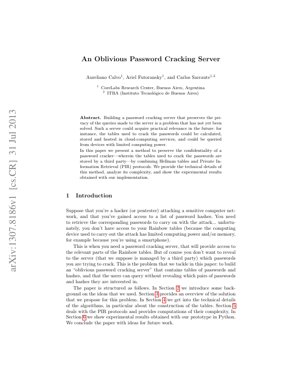
This paper explores a key privacy challenge in offensive security operations: how to perform password cracking via a third-party server without revealing the target hash value. The scenario involves a penetration tester with limited local resources (e.g., a smartphone) who needs to query a large, remotely hosted precomputed hash table (such as a rainbow table or Hellman table). The core problem is to construct anOblivious Password Cracking Server, such that the server cannot learn which password-hash pairs the client is attempting to crack, thereby protecting operational confidentiality.
2. Ilimin Sharefage
2.1 Teburin Juya Hash
Cryptographic systems typically store encrypted hash values of passwords. Attackers use precomputed tables to reverse these hash values. The main methods include:
- Hellman tables (1980): A time-memory trade-off technique using hash and password chains, storing only the start and end points of the chains.
- Rivest's Distinguished Points method (1982): An optimization method that uses special "distinguished" hash values as chain endpoints to reduce lookup operations.
- Rainbow tables (Oeschlin, 2003): Uses different reduction functions at each step of the chain, generally faster but less suitable for the PIR-based query model proposed in this paper.
This paper argues that for this specific application, Hellman tables (or their distinguished point variants) are more compatible with PIR protocols than rainbow tables.
2.2 Bincike na Sirri na Bayanai
Private Information Retrieval allows a client to retrieve an entry from a database without the server learning which entry was accessed. For a single database storing n-bit strings, a PIR scheme involves the following steps:
- Query Generation (Client)
- Query Transmission
- Query Processing (Server)
- Response Transmission
- Response Decoding (Client)
Complexity is measured by $O_C$ (client processing), $O_S$ (server processing), and $O_T$ (transmission). A fundamental lower bound is that $O_S$ must be at least $O(n)$ to ensure privacy, meaning the server must perform work proportional to the database size.
3. Bayyani na Maganin
The proposed solution ingeniously integratesHellman tables(or distinguished point tables) withSingle-Database PIR ProtocolCombined. The server stores precomputed cracking tables. When a client wants to crack a hash value, it uses a PIR query to privately retrieve the necessary information from the specific location in the Hellman table that corresponds to a potential chain match, without revealing the lookup index.
4. Technical Details and Algorithm Construction
The focus of the construction is to adapt Hellman tables to PIR. A Hellman table is defined by a cryptographic hash function $H$ and a reduction function $R$. A chain starts with a plaintext $SP_i$, iteratively computed as: $X_0 = SP_i$, $X_{j+1} = H(R(X_j))$, storing only $(SP_i, EP_i)$, where $EP_i$ is the final value after $t$ steps. To check a hash value $h$, the client computes a chain of length $t$ starting from $h$, checking at each step if an intermediate value matches a stored endpoint. The PIR protocol is used to privately fetch these endpoint comparison results from the server's table.
5. PIR Protocol and Complexity Analysis
This paper analyzes computational and communication overhead. Using a standard computational PIR protocol (e.g., based on the quadratic residuosity assumption), the server-side processing cost $O_S$ grows linearly with table size. The client cost $O_C$ and communication overhead $O_T$ are significantly lower but still non-negligible. The analysis shows that while PIR introduces overhead compared to plaintext queries, it is a necessary cost for achieving strong query privacy. The choice of Hellman tables over rainbow tables here is justified, as rainbow tables require checking multiple columns with different reduction functions, leading to more PIR queries and higher total cost.
6. Experimental Results
A prototype was implemented using Python. Experiments demonstrated the feasibility of the method. Key metrics include:
- Query Time: End-to-end time for a single oblivious cracking attempt, accounting for PIR computation and communication latency.
- Server Load: Computational load on the server per query, confirming the theoretical $O(n)$ bound.
- Success Rate: Probability of successfully cracking a hash given table coverage, which aligns with the success probability of standard Hellman tables.
The results verify the system's effectiveness but also highlight a performance trade-off: privacy protection comes at the cost of increased server computation per query compared to services without privacy protection.
7. Conclusion and Future Work
This paper successfully demonstrates a novel oblivious password cracking server architecture. Future work directions include:
- Exploring more efficient PIR protocols to reduce $O_S$ and $O_T$.
- Investigating the use of Trusted Execution Environments (e.g., Intel SGX) as an alternative or supplement to cryptographic PIR.
- Extending the model to a distributed or multi-server PIR setup to potentially improve performance.
8. Original Analysis and Expert Commentary
Core Insights: The focus of this article is not on cracking passwords faster, but onmore covertlycracking passwords. The author identifies a significant operational gap in offensive security: the digital footprint. When red team members query cloud-based cracking services, that query metadata itself poses a risk. This work proposes using PIR to encrypt the intent itself, rendering the server "oblivious." This is a classic case of applying advanced cryptographic theory (PIR) to a thorny real-world information security problem. Its significance is analogous to privacy considerations in model inversion attacks or membership inference attacks against machine learning APIs, where the queries themselves can leak sensitive information.
Logical Flow: The argument is logically rigorous. 1) Define the threat model: an untrusted third-party server. 2) Select the appropriate cryptographic primitive: computational single-database PIR, the only viable choice in this non-colluding, single-server scenario. 3) Adapt the cracking primitive: choose Hellman tables over rainbow tables because their structure requires fewer, more deterministic PIR queries per cracking attempt. This is a critical engineering decision demonstrating deep domain knowledge. The progression from problem to cryptographic tool to system integration is coherent.
Strengths and Weaknesses: Babban fa'idar ita ce sabuntawa da dacewa kai tsaye. Samfurin ya tabbatar da yuwuwar ra'ayi. Duk da haka, rashin aiki shine rashi. Kudirin aikin PIR yana da girma. Kamar yadda marubutan suka nuna, aikin uwar garken shine $O(n)$. Don manyan teburi (matakin TB), wannan ba zai iya jurewa ga sabis na kasuwanci ba. Wannan shine mafita da ke fifita sirri cikakke maimakon kowane aikin inganci. Bugu da ƙari, yana kare tambaya kawai. Uwar garken har yanzu tana san abokin ciniki yana aiwatar da aikin karya, wanda a wasu yankuna na shari'a zai iya isa ya haifar da faɗakarwa. Idan aka kwatanta da hanyoyin ɓoyayyen bayanai na gaba ɗaya, wannan hanyar ta tushen PIR tana da sauƙi, amma tana da sassauci sosai.
Hanyoyin Aiki: Ga masu aikin tsaro, wannan shiri ne don gina kayan aikin kai hari masu kariya da sirri. Ga masu bincike, yana buɗe hanyoyin bincike akan PIR mai inganci da amfani. Mataki na gaba kai tsaye shine yin gwajin aikin wannan hanyar tare da hanyoyin tushen TEE (misali, gudanar da dabaru na karya a cikin SGX enclave). TEE za ta ɗauki lissafin sirri tare da ƙarancin kuɗi mai yuwuwa fiye da PIR na sirri, ko da yake tana gabatar da amincewa ga masu samar da kayan aiki. Hangen nesa na dogon lokaci ya kamata ya zama ƙirar haɗin gwiwa: amfani da PIR don farkon binciken fihirisa mafi mahimmanci, watakila matakai na gaba suna amfani da kayan aikin amintacce, don daidaita zato na aminci da aiki. Wannan aikin, kamar takardar CycleGAN ta ƙirƙira haɗa cibiyoyin sadarwa don fassarar hoto mara biyu, yana nuna yadda ake haɗa fasahohi biyu masu cikakken ci gaba (Teburin Hellman da PIR) don ƙirƙirar sabbin mafita ga matsala mai rarrabuwa amma mai mahimmanci.
9. Technical Details and Mathematical Formulas
Don aikin hash $H$ da aikin ragewa $R$, ainihin sarkar Hellman an bayyana shi ta hanyar maimaitawa. An ba da farkon bayyanannen rubutu $P_0$:
10. Analytical Framework and Case Studies
Nazarin Lamari: Sabis na Gwajin Shiga cikin Tsaro (PTaaS)
Imagine a cloud-based PTaaS platform offering password auditing services. A client company uploads a list of password hashes from its own systems for a security audit. Using a standard service, the cloud provider would learn which specific hash values correspond to that company's passwords, potentially leading to a data leak. Using an oblivious server framework:
- The client's auditing tool preprocesses each target hash value $h$.
- For each $h$, it locally computes the necessary indices $i_1, i_2, ... i_k$ pointing to the provider's Hellman table.
- It uses a PIR protocol to generate encrypted queries for these indices and sends them to the PTaaS server.
- The server processes all queries (performing work on its entire database) and returns encrypted data blocks.
- The client decrypts the responses and processes them locally, checking if any chain matches are found, thereby recovering the plaintext passwords.
Throughout the process, the PTaaS provider can only see encrypted, seemingly random queries and cannot determine which hash values the client is testing, thereby protecting the confidentiality of the client's internal password set.
11. Future Applications and Directions
The principles of this study can be extended beyond password cracking:
- Privacy-preserving threat intelligence queries: Query indicators of compromise from a shared database without exposing one's own asset information.
- Confidential DNA sequence matching: Hospitals can query genomic databases for disease markers without exposing the patient's complete genome.
- Private Filtering in Log Analysis: Search for attack patterns in shared security logs without exposing your organization's specific vulnerable patterns.
- 与Fully Homomorphic EncryptionThe integration is a key direction. While PIR hides access patterns, FHE can allow servers to perform entire cracking computations on encrypted data, returning only encrypted results. Projects like Microsoft's SEAL and OpenFHE are making this more practical.
- 与Differential PrivacyIntegration can add a layer of statistical privacy, ensuring that even the success or failure of a query does not leak excessive information.
12. References
- Calvo, A., Futoransky, A., & Sarraute, C. (2013). Wani Mai Bincike Mai Bata Kalmar Sirri. arXiv preprint arXiv:1307.8186.
- Hellman, M. (1980). A cryptanalytic time-memory trade-off. IEEE Transactions on Information Theory, 26(4), 401-406.
- Rivest, R. L. (1982). Yadda Ake Sake Amfani da "Ƙwaƙwalwar Ajiya Mai Rubutu-Sau-Ɗaya". (MIT Laboratory for Computer Science Technical Report).
- Oechslin, P. (2003). Making a faster cryptanalytic time-memory trade-off. Advances in Cryptology - CRYPTO 2003 (pp. 617-630). Springer.
- Chor, B., Goldreich, O., Kushilevitz, E., & Sudan, M. (1995). Private information retrieval. Proceedings of IEEE 36th Annual Symposium on Foundations of Computer Science (pp. 41-50). IEEE.
- Zhu, J. Y., Park, T., Isola, P., & Efros, A. A. (2017). Unpaired image-to-image translation using cycle-consistent adversarial networks. Proceedings of the IEEE international conference on computer vision (pp. 2223-2232). (Cited as an example of analogy for creative technical combination).
- Microsoft Research. (n.d.). Microsoft SEAL (Simple Encrypted Arithmetic Library). Retrieved from https://www.microsoft.com/en-us/research/project/microsoft-seal/