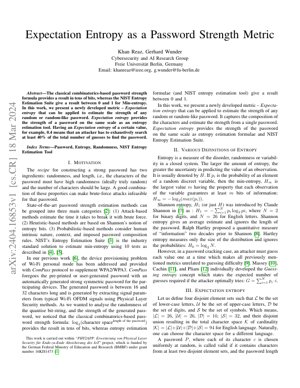
अपेक्षित एन्ट्रॉपी: पासवर्ड सामर्थ्य का मूल्यांकन करने के लिए एक नया मापदंड
Analyze the new metric Expected Entropy, which evaluates password strength on a 0-1 scale, and compare it with classical entropy measures and NIST standards.
होमपेज »
दस्तावेज़ »
अपेक्षित एन्ट्रॉपी: पासवर्ड सामर्थ्य का मूल्यांकन करने के लिए एक नया मापदंड
1. परिचय एवं प्रेरणा
यह लेख परिचयअपेक्षित एन्ट्रॉपी, यह एक नया मीट्रिक है जिसका उद्देश्य यादृच्छिक या यादृच्छिक-जैसे पासवर्डों की शक्ति का मूल्यांकन करना है। इसकी प्रेरणा मौजूदा पासवर्ड शक्ति मूल्यांकन उपकरणों में एक व्यावहारिक अंतराल से उत्पन्न हुई है। शास्त्रीय कॉम्बिनेटरिक्स पर आधारित सूत्र (जैसे $\log_2(\text{वर्ण स्थान}^{\text{लंबाई}})$) दर्जनों बिट्स का आउटपुट देते हैं, जबकि उद्योग-मानक NIST एन्ट्रॉपी अनुमान सूट 0 और 1 के बीच एक सामान्यीकृत न्यूनतम एन्ट्रॉपी स्कोर प्रदान करता है। यह विसंगति प्रत्यक्ष तुलना और सहज व्याख्या को कठिन बना देती है। अपेक्षित एन्ट्रॉपी इस अंतर को पाटती है, जो NIST उपकरणों के समान 0-1 पैमाने पर शक्ति अनुमान प्रदान करती है। उदाहरण के लिए, 0.4 का मान इसका अर्थ है कि हमलावर को पासवर्ड खोजने के लिए कम से कम 40% संभावित अनुमानों का क्रमिक रूप से प्रयास करना होगा।
यह कार्य "PHY2APP" परियोजना के संदर्भ में प्रस्तुत किया गया है, जो Wi-Fi डिवाइस कॉन्फ़िगरेशन (ComPass प्रोटोकॉल) के लिए मजबूत सममित पासवर्ड उत्पन्न करने हेतु भौतिक परत सुरक्षा विधियों का उपयोग करने पर केंद्रित है, जो एक मजबूत, स्केलेबल शक्ति मीट्रिक की आवश्यकता को रेखांकित करता है।
2. एन्ट्रॉपी की विभिन्न परिभाषाएँ
एन्ट्रॉपी अव्यवस्था, यादृच्छिकता या अनिश्चितता को मापती है। विभिन्न परिभाषाएँ क्रिप्टोग्राफ़िक शक्ति के लिए अलग-अलग उपयुक्तता रखती हैं।
2.1 न्यूनतम एन्ट्रॉपी
इसे $H_{\infty} = -\log_2(\max(p_i))$ के रूप में परिभाषित किया जाता है, जहाँ $p_i$ किसी तत्व की प्रायिकता है। यह सबसे खराब स्थिति का प्रतिनिधित्व करता है, सबसे संभावित परिणाम का अनुमान लगाने की कठिनाई को मापता है। यह NIST सुइट के आउटपुट का आधार है।
2.2 शैनन एन्ट्रॉपी
इसे $H_1 = -\sum_{i=1}^{N} p_i \log_2 p_i$ के रूप में परिभाषित किया जाता है। यह सूचना सामग्री का एक औसत माप प्रदान करता है, लेकिन क्रिप्टोग्राफ़िक क्रैकिंग परिदृश्यों में इसकी आलोचना की जाती है क्योंकि यह वास्तविक अनुमान लगाने की कठिनाई से असंबंधित है, क्योंकि यह पासवर्ड लंबाई और हमलावर की इष्टतम रणनीति को नजरअंदाज करता है।
2.3 हार्टली एन्ट्रॉपी
इसे $H_0 = \log_2 N$ के रूप में परिभाषित किया गया है, यह केवल वितरण के आकार (वर्णमाला का आकार) को मापता है और वर्णों की संभावनाओं को पूरी तरह से नजरअंदाज करता है।
2.4 अनुमान एन्ट्रॉपी
इसे $G = \sum_{i=1}^{N} p_i \cdot i$ के रूप में परिभाषित किया गया है, जहाँ अनुमान संभावना के अवरोही क्रम में व्यवस्थित हैं। यह एक इष्टतम हमलावर द्वारा आवश्यकअपेक्षितअनुमानों की संख्या को मापता है। यह वास्तविक क्रैकिंग समय से अधिक सीधे संबंधित है, लेकिन यह सामान्यीकृत नहीं है।
3. अपेक्षित एन्ट्रॉपी
3.1 परिभाषा एवं सूत्र
अपेक्षित एन्ट्रॉपी, अनुमान एन्ट्रॉपी की अवधारणा पर आधारित है, लेकिन [0, 1] पैमाने पर सामान्यीकृत है। इसका मूल विचार एक एकल पासवर्ड की संरचना से उसकी मजबूती का अनुमान लगाना है। यह असंयुक्त वर्ण सेटों पर विचार करती है: लोअरकेस अक्षर $L$ (|L|=26), अपरकेस अक्षर $U$ (26), अंक $D$ (10) और प्रतीक $S$ (32), जो अंग्रेजी के लिए, कुल आकार 94 के वर्ण स्थान $K$ का निर्माण करते हैं।
हालांकि एक एकल पासवर्ड के लिए पूर्ण गणितीय व्युत्पत्ति प्रदानित अंश में संकेतित है लेकिन पूर्णतः स्पष्ट नहीं है, यह मीट्रिक अनिवार्य रूप से एक इष्टतम हमलावर द्वारा आवश्यक कार्य को कुल खोज स्थान के सापेक्ष सामान्यीकृत करती है। यदि $G$ अनुमान एन्ट्रॉपी है, और $N$ संभावित पासवर्डों की कुल संख्या है (उदाहरण के लिए, पूर्ण स्थान के लिए $94^{\text{लंबाई}}$), तो सामान्यीकृत रूप संकल्पनात्मक रूप से $E \approx G / N_{eff}$ से संबंधित हो सकता है, जहां $N_{eff}$ पासवर्ड संरचना को ध्यान में रखने के बाद प्रभावी खोज स्थान का आकार है।
3.2 व्याख्या एवं पैमाना
इसकी प्रमुख नवीनता इसके व्याख्यात्मक पैमाने में निहित है। एक अपेक्षित एन्ट्रॉपी मान $\alpha$ (जहां $0 \le \alpha \le 1$) का अर्थ है कि एक हमलावर को पासवर्ड को क्रैक करने के लिए आवश्यक कुल अनुमानों (इष्टतम क्रम में) के कम से कम $\alpha$ अनुपात को निष्पादित करना होगा। मान 1 आदर्श यादृच्छिकता को दर्शाता है, जहां हमलावर को पूर्ण ब्रूट-फोर्स खोज करनी होगी। यह NIST न्यूनतम एन्ट्रॉपी पैमाने के साथ सहज रूप से संरेखित होता है, जिससे सिस्टम डिजाइनरों के लिए तुलना और निर्णय लेना सुविधाजनक हो जाता है।
4. मूल अंतर्दृष्टि एवं विश्लेषण परिप्रेक्ष्य
मुख्य अंतर्दृष्टि: Reaz और Wunder केवल एक और एन्ट्रॉपी माप प्रस्तावित नहीं कर रहे हैं; वे सुरक्षा इंजीनियरिंग में एक महत्वपूर्णउपयोगिता और व्याख्यात्मकता अंतरालको हल करने का प्रयास कर रहे हैं। वास्तविक समस्या जटिलता माप की कमी में नहीं है, बल्कि उस संज्ञानात्मक घर्षण में है जो तब उत्पन्न होता है जब संयोजन गणितीय उपकरण "80 बिट्स!" चिल्लाते हैं और NIST "0.7" फुसफुसाता है। अपेक्षित एन्ट्रॉपी एक व्यावहारिक अनुवादक है जो क्रिप्टोग्राफ़िक शक्ति को एक एकीकृत डैशबोर्ड पर क्रियाशील, संभाव्य जोखिम स्कोर में बदल देती है।
तार्किक संरचना: तर्क प्रक्रिया संक्षिप्त और सुंदर है: 1) मौजूदा मेट्रिक्स अलग-अलग "ग्रहों" (बिट्स बनाम सामान्यीकृत स्कोर) पर हैं, जिससे भ्रम पैदा होता है। 2) गेसिंग एन्ट्रॉपी ($G$) हमलावर की वास्तविकता के अधिक निकट है, लेकिन यह असीमित है। 3) इसलिए, $G$ को प्रभावी खोज स्थान के सापेक्ष सामान्यीकृत करके एक 0-1 स्कोर बनाया जाता है, जो सीधे हमलावर के आवश्यक कार्यभार के प्रतिशत पर मैप होता है। यह सिद्धांत (NIST की न्यूनतम एन्ट्रॉपी) और व्यवहार (पासवर्ड क्रैकर्स का कार्यभार) के बीच एक पुल का निर्माण करता है।
शक्तियाँ और कमियाँ: इसका लाभ सुंदर सरलता और तत्काल व्याख्येयता में है - जो नीति निर्माताओं और सिस्टम आर्किटेक्ट्स के लिए वरदान है। हालांकि, कठिनाई वितरण धारणा में निहित है। मीट्रिक की सटीकता काफी हद तकएकल पासवर्ड नमूनाआंतरिक वर्ण संभाव्यता वितरण $p_i$ के सही मॉडलिंग पर निर्भर करती है, जो एक सुप्रसिद्ध कठिन सांख्यिकीय समस्या है। NIST सूट द्वारा लंबी बिट स्ट्रीम का परीक्षण करने के विपरीत, इसे एक छोटे 16-वर्ण पासवर्ड पर लागू करने के लिए मजबूत अनुमानकों की आवश्यकता होती है, जो पूर्वाग्रह के प्रति संवेदनशील हो सकते हैं। अंश से देखते हुए, पेपर एकल उदाहरण के लिए इस अनुमान प्रक्रिया को पूरी तरह से विस्तृत नहीं करता है, जो इसकी घातक कमजोरी है।
क्रियान्वयन योग्य अंतर्दृष्टि: सुरक्षा टीमों के लिए, इस मीट्रिक को पासवर्ड निर्माण API या Active Directory प्लग-इन में एकीकृत किया जा सकता है ताकि वास्तविक समय, सहज ज्ञान युक्त सामर्थ्य प्रतिक्रिया प्रदान की जा सके ("आपके पासवर्ड को 60% अनुमान स्थान को क्रैक करने की आवश्यकता है")। शोधकर्ताओं के लिए, अगला कदम मॉडल को कैलिब्रेट करने के लिए वास्तविक दुनिया के क्रैकिंग टूल (जैसे Hashcat या John the Ripper) पर सख्त बड़े पैमाने पर अनुभवजन्य सत्यापन करना होना चाहिए। क्या 0.8 की अपेक्षित एन्ट्रॉपी का वास्तव में अर्थ है 80% खोज स्थान? इसके लिए प्रतिकूल AI मॉडल (उसी तरह जैसे GANs अन्य सुरक्षा डोमेन पर हमला करने के लिए उपयोग किए जाते हैं) के खिलाफ सत्यापन की आवश्यकता है। अवधारणा आशाजनक है, लेकिन इसकी परिचालन व्यावहारिकता मशीन-जनित पासवर्ड के नियंत्रित वातावरण से परे पारदर्शी, सहकर्मी-समीक्षित सत्यापन पर निर्भर करती है।
5. तकनीकी विवरण और गणितीय सूत्र
रूपरेखा वाली अवधारणा के आधार पर, एक पासवर्ड की अपेक्षित एन्ट्रॉपी $H_E$ को वैचारिक रूप से निर्मित किया जा सकता है। मान लीजिए कि लंबाई $l$ का एक पासवर्ड वर्णमाला $\mathcal{A}$ से खींचा गया है, जिसमें प्रत्येक वर्ण स्थिति से जुड़ा एक संबंधित संभाव्यता वितरण है (जिसका अनुमान पासवर्ड से ही या संदर्भ कॉर्पस से लगाया जा सकता है)।
क्रमबद्ध संभाव्यता वेक्टर: पूर्ण पासवर्ड स्थान के आकार $N = |\mathcal{A}|^l$ के लिए, सिद्धांत रूप में सभी संभावित पासवर्डों को उनके चुने जाने की संभावना (जनरेटिव मॉडल के अनुसार) के अवरोही क्रम में क्रमबद्ध किया जा सकता है।
अनुमान एन्ट्रॉपी: एक इष्टतम आक्रमणकारी के लिए अपेक्षित अनुमानों की संख्या $G = \sum_{i=1}^{N} p_i \cdot i$ है, जहां $p_i$ $i$वें सबसे संभावित पासवर्ड की प्रायिकता है।
सामान्यीकरण: एक समान वितरण के लिए अधिकतम संभव $G$ $(N+1)/2$ है। कार्यभार का एक सामान्यीकृत माप इस प्रकार परिभाषित किया जा सकता है:
व्यावहारिक अनुमान: एक एकल पासवर्ड के लिए, इसकी "रैंक" या इससे अधिक संभावित सभी पासवर्डों की संचयी प्रायिकता का अनुमान लगाना चाहिए। यदि किसी पासवर्ड की उसकी रैंक तक की संचयी प्रायिकता द्रव्यमान $\alpha$ है, तो $H_E \approx 1 - \alpha$। यह पेपर के विवरण के अनुरूप है कि 0.4 का मान 40% स्थान की खोज को दर्शाता है।
एक एकल नमूने से इसे अनुमानित करने के लिए एक सटीक, कुशल एल्गोरिदम लेखकों द्वारा संकेतित मुख्य तकनीकी योगदान है।
6. प्रयोगात्मक परिणाम और चार्ट स्पष्टीकरण
नोट: प्रदान की गई PDF अंश में विशिष्ट प्रयोगात्मक परिणाम या चित्र शामिल नहीं हैं। निम्नलिखित इस प्रकार के मेट्रिक्स के लिए विशिष्ट सत्यापन अध्ययन सामग्री के आधार पर वर्णन है।
अपेक्षित एन्ट्रॉपी के व्यापक मूल्यांकन में निम्नलिखित चित्र शामिल हो सकते हैं:
चित्र 1: मेट्रिक तुलना स्कैटर प्लॉट। यह चित्र दो अक्षों पर पासवर्ड प्लॉट करेगा: X-अक्ष शास्त्रीय बिट स्ट्रेंथ (जैसे $\log_2(94^l)$) दिखाता है, Y-अक्ष अपेक्षित एन्ट्रॉपी (0-1) दिखाता है। बिंदुओं का बादल दो मापों के बीच सहसंबंध (या इसकी कमी) को प्रकट करेगा, उन पासवर्ड को उजागर करते हुए जो लंबे (उच्च बिट स्ट्रेंथ) लेकिन अनुमानित (कम अपेक्षित एन्ट्रॉपी) हैं।
चित्र 2: क्रैक प्रतिरोध वक्र। यह दिखाएगा कि एक हमलावर (Hashcat जैसे टूल का उपयोग करके नियम-आधारित हमला) को अपेक्षित एन्ट्रॉपी स्कोर (जैसे 0.0-0.1, 0.1-0.2...) के अनुसार समूहीकृत पासवर्ड को क्रैक करने के लिए वास्तविक खोज स्थान के कितने अनुपात से गुजरना होगा। आदर्श मीट्रिक एक पूर्ण विकर्ण रेखा दिखाएगा, जहां अनुमानित कार्यभार (एन्ट्रॉपी) वास्तविक कार्यभार के बराबर होगा। विकर्ण से विचलन अनुमान त्रुटि को दर्शाता है।
चार्ट 3: स्कोर वितरण भूखंड। विभिन्न प्रकार के पासवर्ड के अपेक्षित एन्ट्रॉपी स्कोर का हिस्टोग्राम प्रदर्शित करता है: मशीन-जनित (जैसे ComPass प्रोटोकॉल से), नियमित मानव-जनित और अनियमित मानव-जनित। यह इस मीट्रिक की विभिन्न पासवर्ड जनन विधियों के बीच अंतर करने की क्षमता का दृश्य प्रदर्शन करेगा।
सत्यापन के लिए आवश्यक प्रमुख परिणाम यह दावा है: "एक निश्चित मान की अपेक्षित एन्ट्रॉपी होना, उदाहरण के लिए 0.4, का अर्थ है कि हमलावर को कुल अनुमानों के कम से कम 40% को समाप्त करना होगा।" इसके लिए अनुभवजन्य हमला सिमुलेशन की आवश्यकता है।
7. विश्लेषणात्मक ढांचा: उदाहरण केस
परिदृश्य: 94 प्रिंटेबल ASCII वर्ण स्थान का उपयोग करने वाली एक प्रणाली में दो 12-वर्ण पासवर्ड का मूल्यांकन करें।
पासवर्ड A (मानव-चयनित):Summer2024!
पासवर्ड B (मशीन-जनित):k9$Lp@2W#r1Z
शास्त्रीय बिट सामर्थ्य: दोनों का सैद्धांतिक अधिकतम समान है: $\log_2(94^{12}) \approx 78.7$ बिट्स।
अपेक्षित एन्ट्रॉपी विश्लेषण:
पासवर्ड A: संरचना बहुत सामान्य है: एक शब्दकोश शब्द ("Summer"), एक अनुमानित वर्ष ("2024"), और एक सामान्य प्रत्यय प्रतीक ("!")। एक संभाव्यता मॉडल (जैसे लीक हुए पासवर्ड पर प्रशिक्षित मार्कोव श्रृंखला) इस पैटर्न को उच्च संभावना प्रदान करेगा। संभावित पासवर्डों की क्रमबद्ध सूची में इसकी रैंक बहुत कम होगी, जिसका अर्थ है कि अधिक संभावित पासवर्डों की संचयी संभावना अधिक है। इसलिए, इसकी अपेक्षित एन्ट्रॉपीबहुत कम होगी (उदाहरण के लिए 0.05-0.2), यह दर्शाता है कि हमलावर के लिए अनुकूलित अनुमान क्रम के पहले 5-20% के भीतर इसे खोजना बहुत संभावित है।
पासवर्ड B: यह यादृच्छिक दिखता है, कोई स्पष्ट पैटर्न नहीं है, प्रत्येक स्थान पर वर्ण सेट का मिश्रण है। एक संभाव्यता मॉडल इस विशिष्ट अनुक्रम को बहुत कम, लगभग समान संभावना प्रदान करेगा। इसकी रैंक बहुत अधिक होगी (क्रमबद्ध सूची के मध्य/अंत के निकट)। इसलिए, इसकी अपेक्षित एन्ट्रॉपीबहुत अधिक होगी (उदाहरण के लिए 0.7-0.95), यह दर्शाता है कि हमलावर को अधिकांश स्थान की खोज करनी होगी।
यह उदाहरण दर्शाता है कि कैसे अपेक्षित एन्ट्रॉपी समान बिट स्ट्रेंथ के लिए क्लासिक फॉर्मूला की तुलना में अधिक सूक्ष्म और यथार्थवादी जोखिम मूल्यांकन प्रदान करती है।
8. अनुप्रयोग संभावनाएं और भविष्य की दिशाएं
प्रत्यक्ष अनुप्रयोग:
रियल-टाइम पासवर्ड स्ट्रेंथ मीटर: वेब और एप्लिकेशन पंजीकरण प्रवाह में अपेक्षित एन्ट्रॉपी को एकीकृत करना, जो उपयोगकर्ताओं को एक सहज, प्रतिशत-आधारित स्ट्रेंथ संकेतक प्रदान करता है।
सुरक्षा नीति प्रवर्तन: संगठन न्यूनतम अपेक्षित एन्ट्रॉपी थ्रेशोल्ड (उदाहरण के लिए 0.6) सेट कर सकते हैं, केवल जटिलता नियमों के बजाय, सीधे रणनीति को अनुमानित क्रैकिंग कार्यभार से जोड़कर।
स्वचालित सिस्टम ऑडिट: मौजूदा पासवर्ड डेटाबेस (हैश मान) को सामूहिक अपेक्षित एन्ट्रॉपी वितरण का अनुमान लगाने और गंभीर रूप से कमजोर पासवर्ड वाले खातों की पहचान करने के लिए स्कैन करें।
भविष्य के शोध के दिशा-निर्देश:
मजबूत एकल-नमूना अनुमानक: सटीक अनुमान लगाने के लिए सांख्यिकीय विधियों (जैसे तंत्रिका भाषा मॉडल, n-gram मॉडल या ब्लूम फ़िल्टर का उपयोग करके) का विकास और तुलना करेंएकलपासवर्ड की संभावना/रैंक, और इससे व्युत्पन्न $H_E$।
प्रतिकूल मूल्यांकन: इस मीट्रिक का परीक्षण अत्याधुनिक पासवर्ड क्रैकिंग टूल और AI मॉडल (जैसे PassGAN, पासवर्ड के लिए अनुकूलित एक जनरेटिव एडवरसैरियल नेटवर्क फ्रेमवर्क) के खिलाफ करना, ताकि यह देखा जा सके कि अनुमानित कार्यभार वास्तविक क्रैकिंग समय से मेल खाता है या नहीं।
पासवर्ड से परे: सामान्यीकृत "कार्यभार अनुपात" की अवधारणा को अन्य रहस्यों, जैसे एन्क्रिप्शन कुंजियाँ (जहाँ बिट्स मानक हैं) या बायोमेट्रिक टेम्पलेट्स पर लागू करना, ताकि विभिन्न प्रमाणीकरण कारकों में एक समान सामर्थ्य माप बनाया जा सके।
मानकीकरण प्रयास: NIST जैसे निकायों को अपेक्षित एन्ट्रॉपी या उसके सिद्धांत को भविष्य के डिजिटल पहचान दिशानिर्देशों (जैसे SP 800-63B) के संशोधन में शामिल करने का प्रस्ताव देना।
9. संदर्भ सूची
जर्मन संघीय शिक्षा और अनुसंधान मंत्रालय (BMBF)। PHY2APP परियोजना वित्तपोषण विवरण।
M. Dell'Amico, P. Michiardi, Y. Roudier, "Password Strength: An Empirical Analysis," in Proceedings of IEEE INFOCOM, 2010. (पासवर्ड स्ट्रेंथ विधियों के सर्वेक्षण का प्रतिनिधित्व करता है)।
अमेरिकी राष्ट्रीय मानक और प्रौद्योगिकी संस्थान (NIST)।एन्ट्रॉपी आकलन सूट। [ऑनलाइन]। उपलब्ध: https://github.com/usnistgov/entropy-estimation
NIST विशेष प्रकाशन 800-90B।यादृच्छिक बिट जनन के लिए एन्ट्रॉपी स्रोत सिफारिशें।
J. Kelsey, K. A. McKay, M. Turan, "Predictive Models for Min-Entropy Estimation," in Proceedings of CHES, 2015.
K. Reaz, G. Wunder, "ComPass: A Protocol for Secure and Usable Wi-Fi Device Provisioning," in Proceedings of ACM WiSec, 2023. (संदर्भ के आधार पर अनुमानित)।
C. E. Shannon, "A Mathematical Theory of Communication," The Bell System Technical Journal, vol. 27, pp. 379–423, 623–656, 1948.
आर. वी. एल. हार्टली, "सूचना का संचरण," The Bell System Technical Journal, खंड 7, अंक 3, पृष्ठ 535–563, 1928.
जे. बोनो, "अनुमान लगाने का विज्ञान: 70 मिलियन पासवर्ड के एक गुमनाम कॉर्पस का विश्लेषण," में प्रोसीडिंग्स ऑफ़ आईईईई सिम्पोज़ियम ऑन सिक्योरिटी एंड प्राइवेसी, 2012.
जे. एल. मैसी, "अनुमान और एन्ट्रॉपी," में प्रोसीडिंग्स ऑफ़ आईईईई इंटरनेशनल सिम्पोज़ियम ऑन इन्फॉर्मेशन थ्योरी (आईएसआईटी), 1994.
सी. कैचिन, एन्ट्रॉपी माप और क्रिप्टोग्राफी में बिना शर्त सुरक्षा। पीएचडी शोध प्रबंध, स्विस फेडरल इंस्टीट्यूट ऑफ टेक्नोलॉजी ज्यूरिख, 1997।
J. O. Pliam, "The Disparity between Work and Entropy in Cryptology," 1998. [ऑनलाइन]। उपलब्ध: https://eprint.iacr.org/1998/024
B. Hitaj, P. Gasti, G. Ateniese, F. Perez-Cruz, "PassGAN: A Deep Learning Approach for Password Guessing," में Proceedings of ACNS, 2019. (प्रतिकूल AI मूल्यांकन के लिए बाहरी संदर्भ)।